Sector: Real estate
ROLE ID Case Study
Challenge
The organization's role and assignment management process relied on several manual workflows that made employee transitions, role changes, and assignment management time-consuming and error-prone. The system needed to support scalable assignment operations while ensuring role-based business rules were consistently applied across properties, markets, and regions.
My Role
UX research Facilitation, Information Architecture, User testing, Prototyping, Dashboard design
I was the sole UX & frontend engineer to create a corporate bond trading dashboard.
Project Time
12 days (before handoff to development)
WHY OUR PRODUCT?
ROLE ID is an internal platform used to assign roles and manage employee responsibilities across properties, markets, and regions.
What happens when an employee changes roles, transfers to a different region, or leaves the organization?
How can administrators ensure that all related assignments are accurately updated without manually reviewing every dependency?
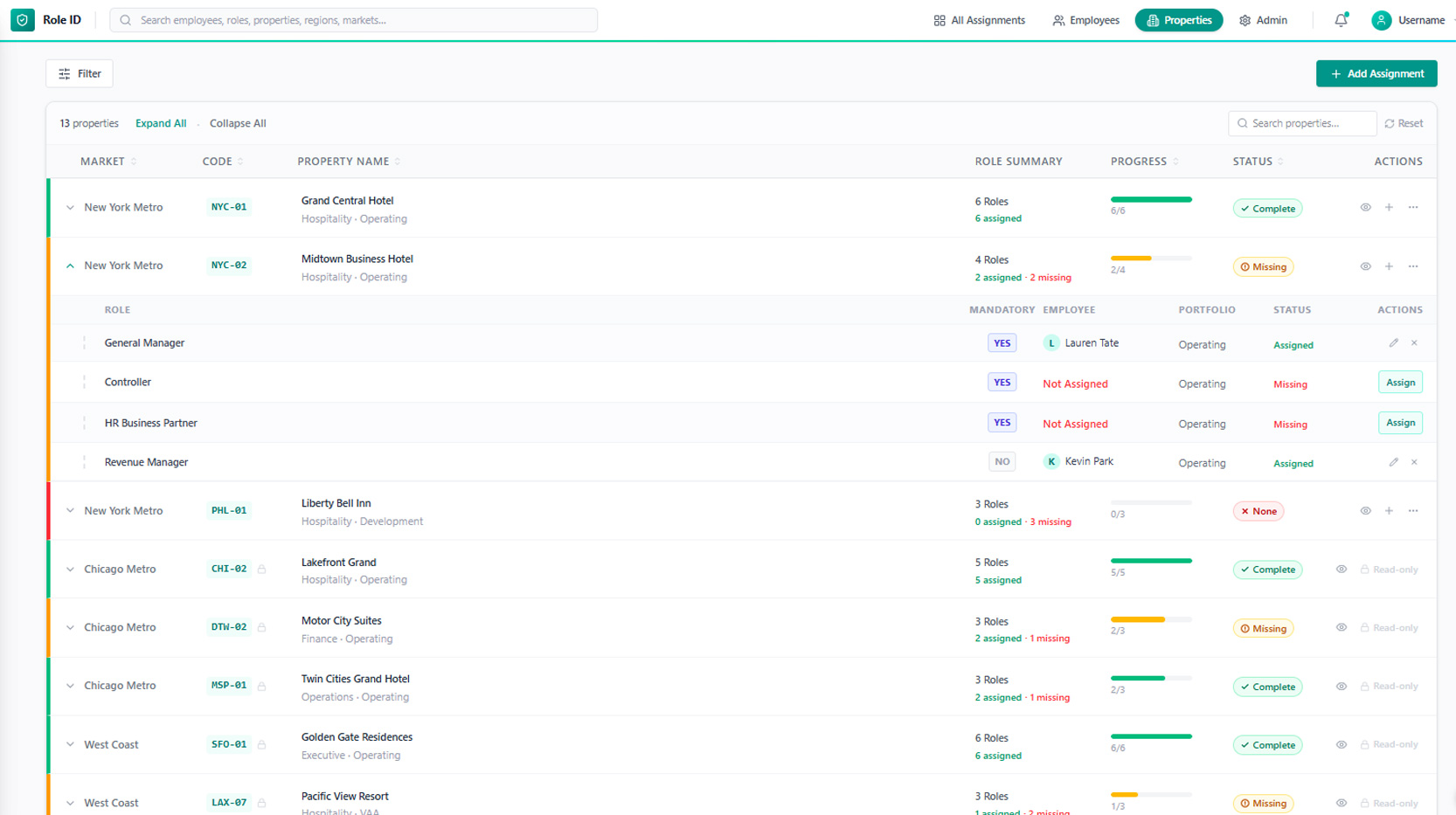
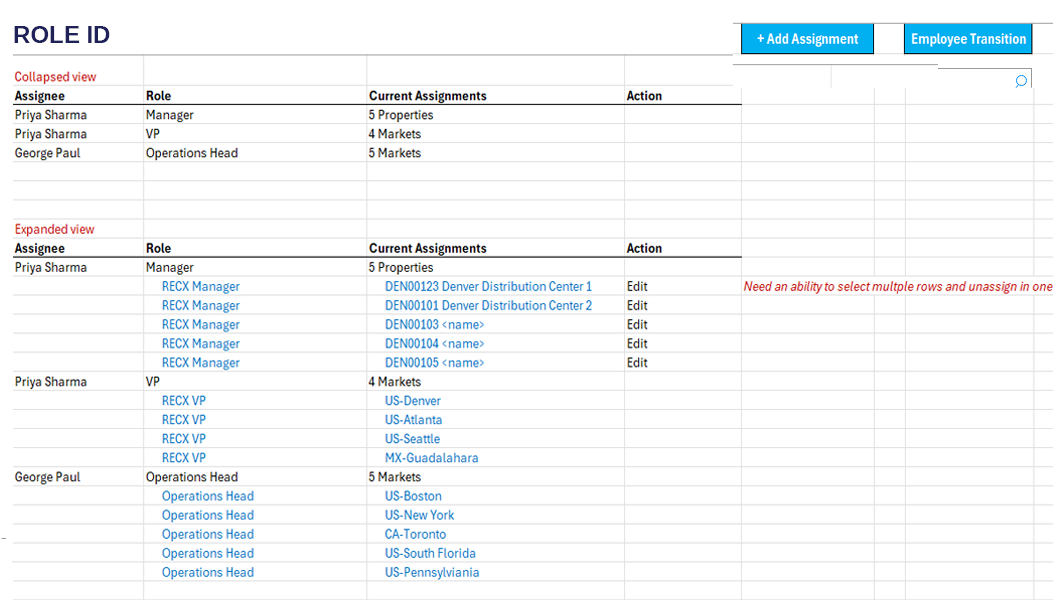
A key challenge was designing a system that could automatically unassign role-based assignments during employee transitions while supporting bulk assignment and bulk unassignment actions. The solution also needed to provide administrators with clear visibility into assignment status, mandatory role gaps, and organizational coverage, enabling faster and more confident workforce management.
Talking to end users
I found that the primary users were administrators, operational managers, HR teams and employees.
To better understand their workflows, I spoke with the product owner, stakeholders, business analysts, and administrators who used the existing system daily. These conversations helped uncover how role assignments were managed, how employee transitions were handled, and where users experienced friction.
Some of the biggest pain points came from the amount of manual effort required to maintain assignments, when an employee changed roles, moved to another region, or left the organization.
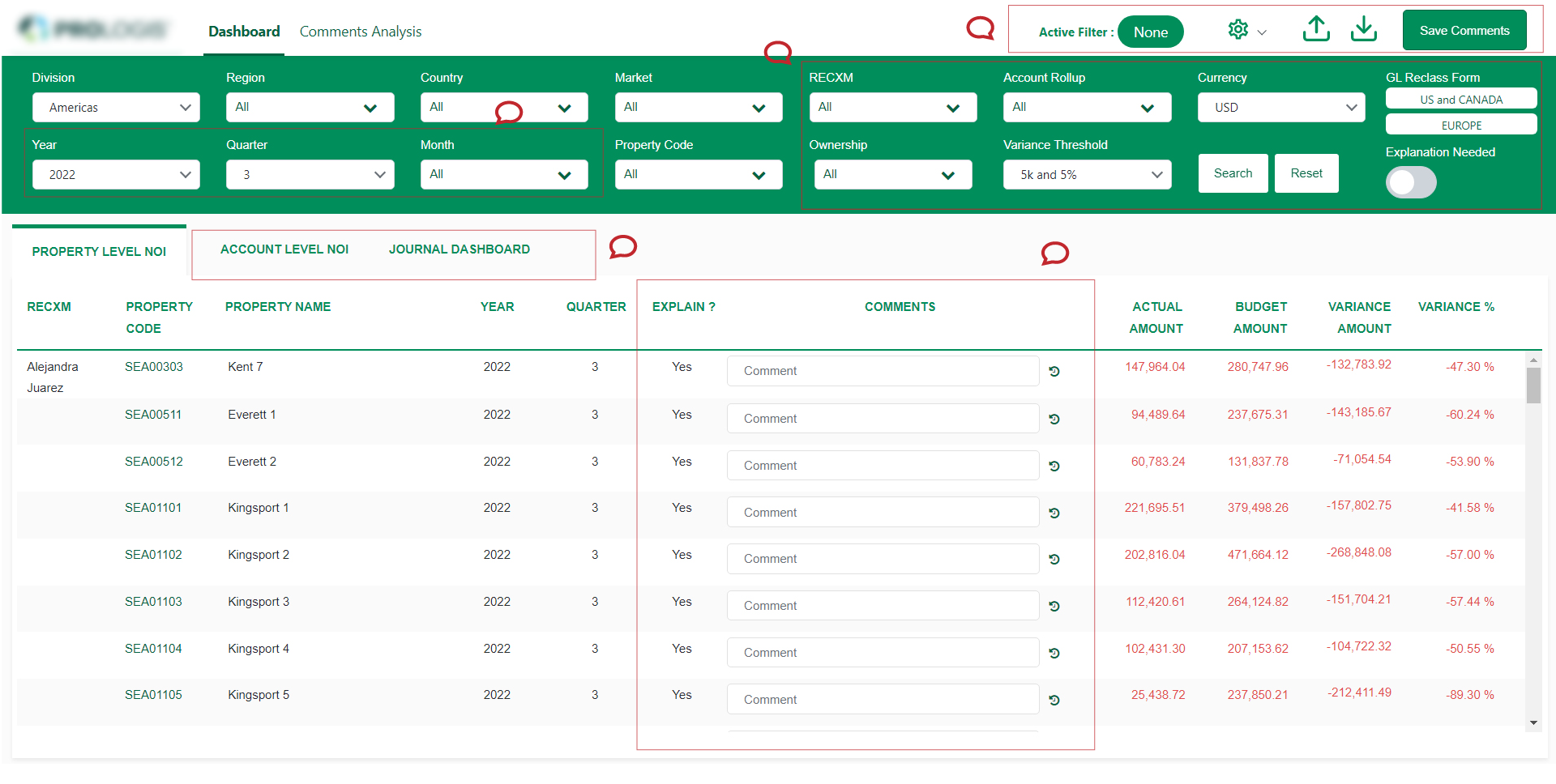
Crowded
Filters
Ease to use
Problem
I also noticed that users had limited visibility into unassigned properties, missing mandatory roles, and assignment changes caused by employee transitions. The absence of efficient bulk actions further increased the effort required to manage assignments
To further my research, I reviewed role and access management systems used across enterprise platforms. Some key takeaways from successful solutions included:
- Automated assignment and unassignment workflows
- Clear role hierarchy and configuration rules
- Visibility into exceptions, gaps, and mandatory role coverage
- Actionable insights and status indicators
Main Objective
The application is used to manage employee roles and assignments across properties, markets, and regions. Our goal was to simplify assignment management by reducing manual effort, improving visibility, and streamlining employee transition workflows
We focused on enabling automated unassignment updates, efficient bulk actions, and a more intuitive administration experience.


Starting with Questions...
We created a list of ‘How Might We…’ questions to help us better align our user’s tasks and goals:
- How might we automate assignment and unassignment workflows during employee transitions while ensuring role-based rules are maintained?
- How might we help administrators quickly identify unassigned properties, missing mandatory roles, and assignment gaps across the organization?
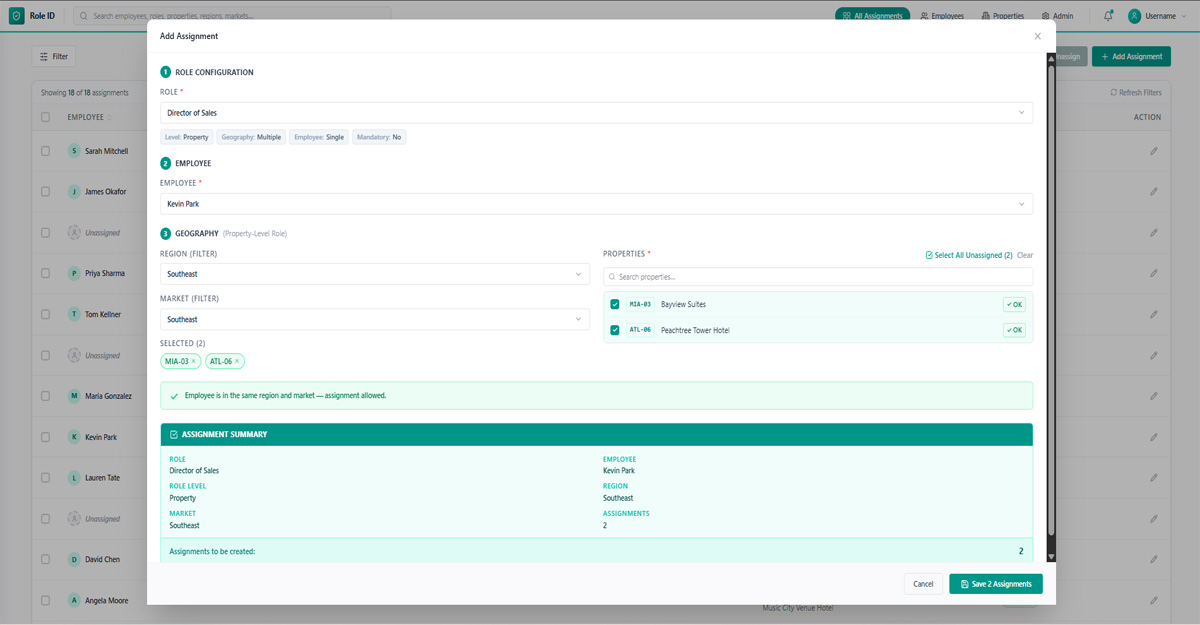
- How might we enable efficient bulk assignment and bulk unassignment actions for large-scale organizational changes?
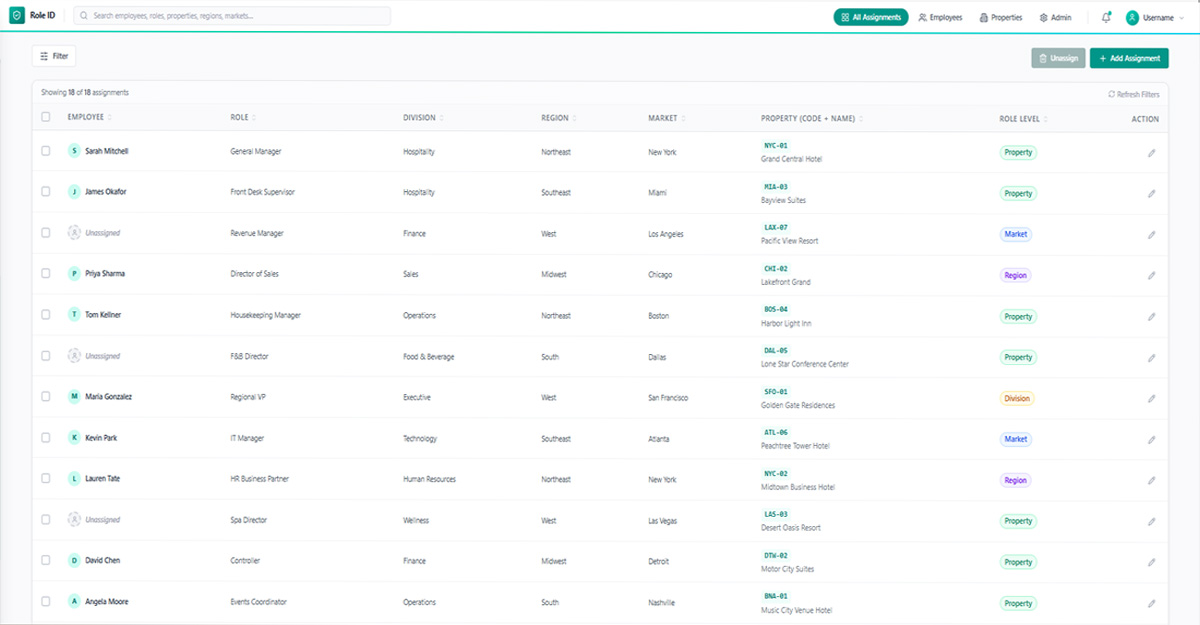
- How might we provide administrators with a centralized view of roles, employees, and assignments to simplify decision-making?
The Redesign Process
Card Sorting
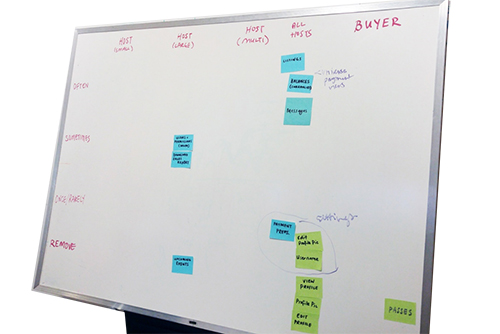
To better understand the relationships between employees, roles, properties, markets, and regions, I facilitated mapping exercises with stakeholders. This helped define the hierarchy of assignments, role dependencies, and business rules required for automated transitions. The exercise also helped determine which actions should be automated and which required administrator oversight.
Internal Feedback
I gathered feedback from administrators and business users to identify opportunities for improvement and potential quick wins. The objective was to understand which tasks created the most friction and where automation could provide the greatest value.
Some of the feedback we got back was:
"Employee transitions require too many manual updates across assignments."
"We need an easier way to perform bulk assignments and unassignments."
"It's difficult to identify missing mandatory roles and unassigned properties."
"Administrators need better visibility into assignment status and role coverage."
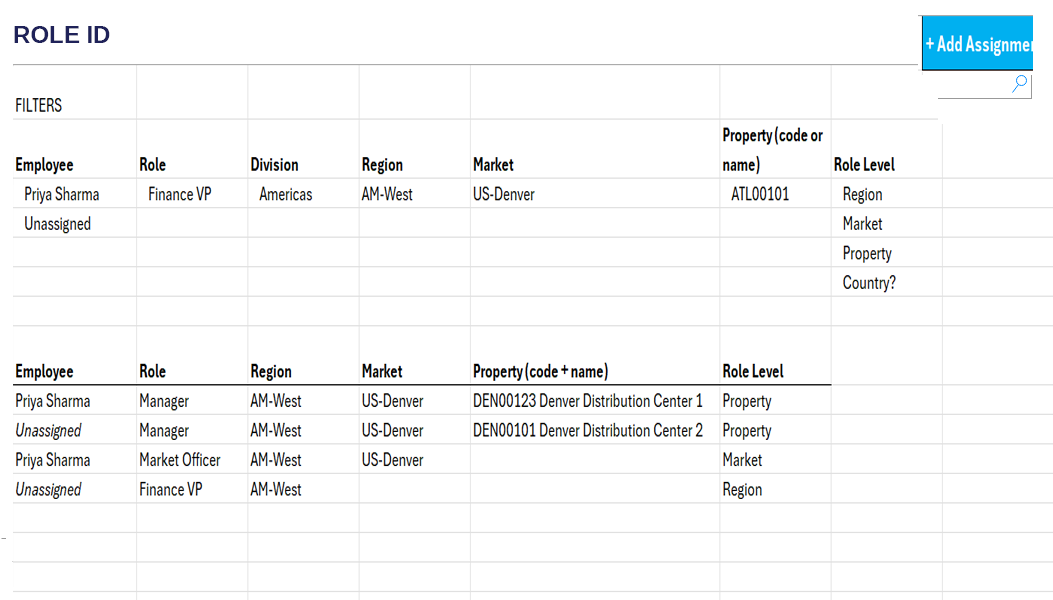
The Wireframe
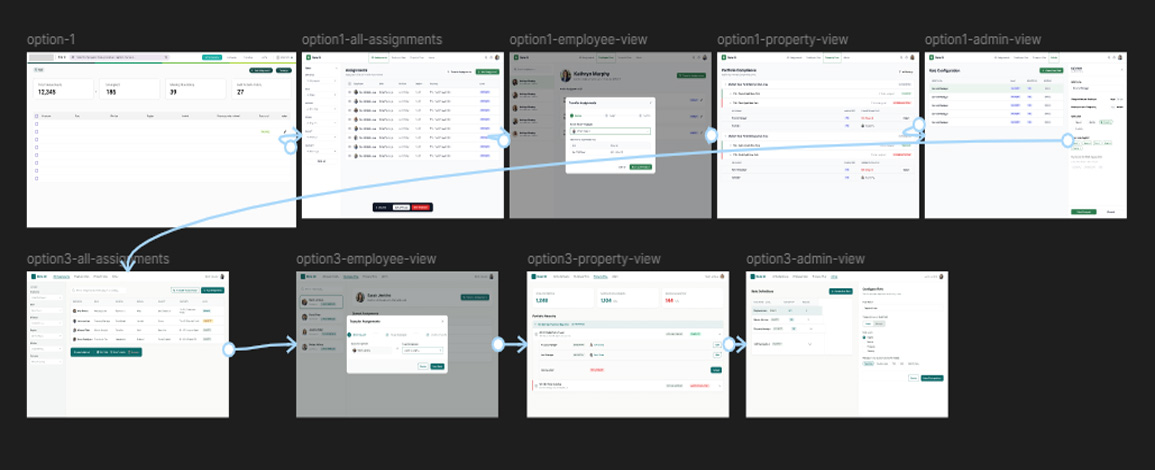
To validate these findings, I designed a simple overview of the landing page, two options where provided.
A/B testing
After creating the initial designs, I developed an interactive high-fidelity prototype and shared it with administrators and business stakeholders for review. Early feedback showed a clear improvement in how users navigated role configurations, managed assignments, and handled employee transitions.
Iterate, Iterate and Iterate
Based on research findings, stakeholder feedback, and prototype testing, we focused on three key areas:
- Simplify role and assignment management
- Automate employee transition workflows
- Improve visibility into role coverage and assignment gaps
Solution
The MVP
To validate these findings, I designed a simple clickable prototype in Figma, and given for user testing which was changed again and again as per suggestions/feedbacks we received.
Challenges and Compromises
Due to time and development constraints, we focused on delivering the highest-value features first.
- Instead of implementing fully automated assignment recommendations, the MVP focused on automated unassignment and administrator-controlled reassignment workflows.
- Rather than building advanced analytics, we prioritized key metrics such as Unassigned, Missing Mandatory Roles, and Bulk Actions to provide immediate value to users.
Next Steps
The redesigned Role ID experience streamlined role and assignment management by reducing manual effort and improving efficiency. Future enhancements could include assignment recommendations, advanced reporting, and assignment history.
Note: To meet a tight project timeline, I leveraged AI-powered tools along with Figma AI and Figma Make to rapidly generate concepts, iterate designs, and deliver an interactive high-fidelity prototype. This significantly accelerated the design process and enabled faster stakeholder feedback and validation.